
- Why Risk Categories Matter When You’re Building in 2025
- What’s your building’s Risk Category?
- What Are Risk Categories for Metal Buildings?
- The 3 Risk Categories
- Why This Affects Your Metal Building Design
- Who Decides the Risk Category?
- Common Metal Building Examples by Risk Category
- Buyer Tips for Risk Category Compliance
- What Happens if You Choose the Wrong Risk Category?
- Want to Make Sure Your Building Complies?
- Risk Categories FAQs
- Category I
- Category II
- Category III
- TL;DR: Metal Building Risk Categories – Key Takeaways
- Q: What is Metal Buildings Risk Category I?
- Q: What is the difference between Risk Category I and II?
- Q: What happens if I use the wrong Risk Category?
- Q: How do I find out which Risk Category applies to my project?
Why Risk Categories Matter When You’re Building in 2025
You’re ready to build a metal garage, barn, or commercial structure, but before you pick colors or door styles, there’s one critical thing most buyers overlook:
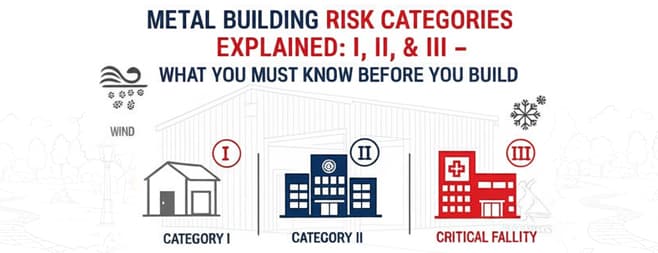
Category I
Low-risk structures like open carports, farm sheds, or barns not meant for people to gather or work inside the building.
Category II
Most common, used for garages, workshops, and retail spaces with regular occupancy.
Category III
High-importance buildings like churches, gyms, fire stations, or public-use facilities. They follow stricter building codes.
TL;DR: Metal Building Risk Categories – Key Takeaways
- Risk Categories define the level of criticality for your building’s safety and help determine its design specifications for wind, snow, and seismic loads.
- The higher the category, the tougher the requirements:
- Your local permit office typically assigns a risk category based on how the building will be used and its location.
- Stronger framing & anchoring, higher wind and snow load ratings (especially in states like FL, NC, or CO), more detailed engineering & inspections.
What’s your building’s Risk Category?
Whether you’re building in Texas, North Carolina, or out in rural farmland, understanding Risk Categories I, II, and III can make or break your project, especially when it comes to wind loads, permitting, and safety compliance.
This guide simplifies it all, no engineering degree required.
What Are Risk Categories for Metal Buildings?
When you build with steel, whether it’s a carport, garage, a shop, or a large commercial building, your structure must meet specific safety standards. One of the first things engineers consider is how much risk is involved if the building were to fail during something like a windstorm, snowload event, or even an earthquake.
That’s where Risk Categories come in.
They’re part of the rules set by the International Building Code (IBC), and most U.S. counties follow them. These categories help determine stuff like:
- What kind of weather loads your building must handle
- Whether you need upgraded framing or anchoring
- What your local permit office is going to require
- And even how your insurance company sees the risk
Bottom line: it’s all about how important your building is to people’s safety. A backyard storage shed? Low risk. A fire station or school gym? Higher risk, more rules.
The 3 Risk Categories
| Category | Definition | Example Buildings |
|---|---|---|
| I | Low-risk structures where failure poses minimal danger | Storage sheds, agricultural barns, non-occupied carports |
| II | Standard occupancy – the default for most buildings | Homes, garages, workshops, retail buildings |
| III | Public assembly or essential-use facilities | Churches, schools, fire stations, community centers |
For most carports, garages, and metal barns, you’re dealing with Risk Category I or II, but if your building is for public use or tied to critical services, Category III may apply.
Why This Affects Your Metal Building Design
- 1. Wind Load Requirements
Category II & III buildings require higher wind ratings. Florida, coastal, or hurricane-prone zones may require 150+ MPH ratings. - 2. Snow Load Ratings
Northern or mountain states demand higher snow loads for Category II+. Design must comply with ASCE 7-16 or ASCE 7-22. - 3. Foundation Engineering
Higher risk categories may trigger stricter footing and anchoring specs. - 4. Permitting & Inspection
Most building departments require stamped engineering plans. Higher risk = more surveys during inspection phases.
Who Decides the Risk Category?
Usually, your local building authority or permitting office will assign a Risk Category based on:
- Building use and occupancy
- Location (wind/snow/seismic zone)
- Public access or emergency functionality
Common Metal Building Examples by Risk Category
| Use Case | Risk Category | Notes |
|---|---|---|
| Detached farm equipment storage | I | No occupancy, limited hazard |
| Enclosed residential metal garage | II | Default for homes and small workshops |
| Auto service garage (open to public) | III | Public use triggers upgrade |
| Church fellowship hall or gymnasium | III | Large gatherings = higher design threshold |
| Data server building or small hospital | IV | Rare – not typical for standard metal dealers |
Buyer Tips for Risk Category Compliance
- Tell your dealer the intended use upfront
- Ask for wind/snow load calculations tied to Risk Category
- Ensure your engineering package is stamped and local-code compliant
- In Florida, Texas Gulf Coast, or NC coast? Ask for FL/IBC engineering
- If unsure, call your county building office – most can clarify in 5 minutes
What Happens if You Choose the Wrong Risk Category?
- Permit rejection
- Structure may not meet wind/snow load requirements
- Higher insurance premiums
- Unsafe installation and potential liability
If your building fails inspection, you may have to re-engineer the design, pay for structural upgrades, or start over entirely.
Want to Make Sure Your Building Complies?
- Talk to our (866) 681-7846 Building Advisor
- Get a Free Permit-Ready Quote
- Explore Metal Garages & Custom Structures
Risk Categories FAQs
Q: What is Metal Buildings Risk Category I?
Risk Category I applies to buildings with low human occupancy, such as open carports, storage sheds, and barns not intended for living or public use.
Q: What is the difference between Risk Category I and II?
Category I is for low-risk, non-occupied structures. Category II is standard for homes, enclosed garages, and most retail or workspace buildings with regular human use.
Q: What happens if I use the wrong Risk Category?
Your building may fail inspection, require costly redesigns, or not qualify for a permit, leading to project delays and higher costs.
Q: How do I find out which Risk Category applies to my project?
Contact your local building department or Get Carports to confirm, based on your location and intended use.