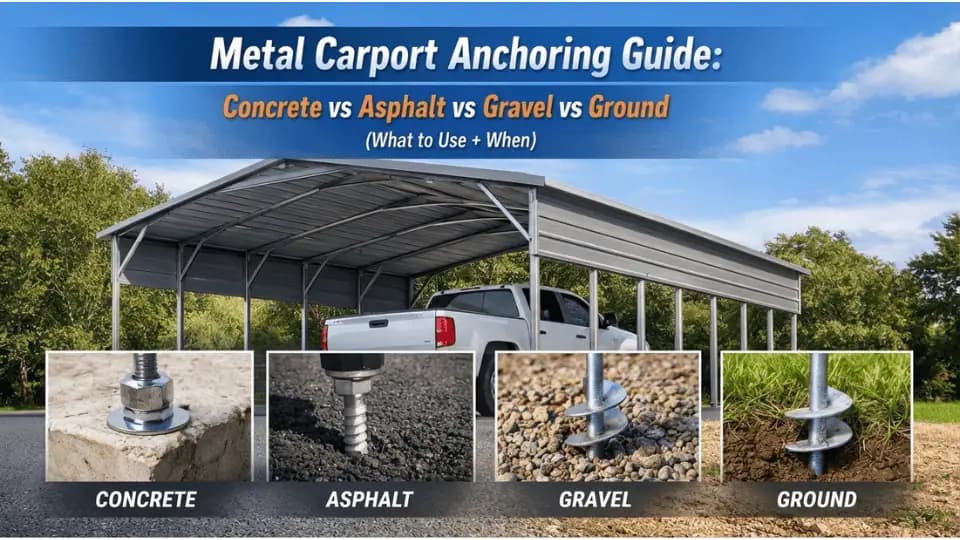
A metal carport can look “heavy enough” to stay put, until the first real wind event, a wet season that softens the soil, or a freeze-thaw cycle that shifts your site just enough to rack the frame.
Anchoring is what turns a carport from “set in place” to “secured in place.” And the right anchors depend on one thing more than anything else: what the carport is sitting on.
At Get Carports, the most common anchor types offered are asphalt, concrete, mobile home (auger), and rebar anchors, and each one matches specific foundation conditions.
TL;DR (quick picks)
- Concrete slab → Concrete wedge/expansion anchors (best for permanent installs, certified builds, higher wind needs).
- Asphalt driveway → Asphalt anchors (barbed/drive style) or rebar driven through into soil (works when asphalt is thick enough and the base under it is solid).
- Gravel pad → Usually mobile home (auger) anchors; sometimes rebar pins in mild conditions (the pad still needs proper prep and compaction).
- Ground (dirt/soil/grass) → Mobile home (auger) anchors (the go-to when there’s no slab, especially in wind-prone areas).
Why the surface matters (and why “any anchor” is a bad bet)
Anchors are designed around how the base material holds load:
- Concrete holds by compression and friction inside a drilled hole (expansion/wedge action).
- Asphalt is flexible and softer, so concrete-style expansion anchors can loosen or pull out. Asphalt anchors are built to bite and transfer load into the ground beneath
- Soil and gravel hold by embedment and resistance in the earth (auger/helix “screw-in” holding power, or a stake/pin in mild conditions)
If you match the wrong anchor to the wrong surface, you can end up with a carport that slowly walks out of square, lifts at one corner, or fails inspection when you need a permit.
The anchor types you’ll hear about
1) Concrete anchors (wedge/expansion style)
- Installed by drilling through the base rail and into the slab, then tightening so the anchor expands and grips the concrete.
- Best for: slabs, certified buildings, permanent installs.
Contractor note: Many code-listed wedge anchors require following manufacturer instructions for hole diameter, embedment, and cleaning dust out of the hole before tightening.
2) Asphalt anchors (drive/barbed style) and “through-asphalt” methods
- Designed for asphalt’s softer nature and typically driven/installed so they lock in the asphalt and/or transfer load into the soil below.
- Best for: existing driveways when you do not want to pour concrete.
Watch-out: Some systems specify a minimum asphalt thickness (commonly cited around 2.5 inches for certain barbed-drive styles). If your driveway is thinner or deteriorated, you may be better off with a slab or another foundation plan.
3) Mobile home anchors (auger/helical anchors)
- Big corkscrew-style anchors that twist deep into soil; they are widely used for carports installed on dirt or gravel.
- Best for: ground installs, gravel pads, and areas where you need serious uplift resistance without pouring a slab.
4) Rebar anchors (pin/stake anchors)
- Long steel pins driven through the base rail into the ground. Often cited around the 36-inch range, but lengths vary by installer and site.
- Best for: mild wind areas, firm soils, and sometimes as supplemental anchoring.
If you are in a higher wind zone or trying to meet certification requirements, many installers treat rebar-only installs as a weak link compared with augers or slab anchors.
Quick decision guide (what to use + when)
If you want the simplest “do-this” rule:
- Permanent + strongest + easiest to inspect: concrete slab + concrete anchors
- Already have a driveway: asphalt anchors (only if the asphalt and base are in good shape)
- Budget-friendly but still solid when prepped right: compacted gravel pad + mobile home anchors
- Fastest “no slab” install: level ground + mobile home anchors
These recommendations line up with widely used anchor guidance across the industry.
Foundation-by-foundation: what to use, when, and what to watch
Use concrete wedge/expansion anchors.
When concrete is the right call
- You want a permanent carport that feels like part of the property.
- You are adding enclosed panels, storage, or upgrading toward a garage later.
- Your county is permit-heavy or you need certified wind/snow loads (slab anchoring is commonly used in those builds)
Concrete slab anchoring basics (what homeowners should know)
- Edge distance matters. Installers often avoid placing concrete anchors too close to the slab edge to reduce cracking or breakout (a commonly mentioned rule of thumb is about 4 inches from the edge, but follow your building’s requirements).
- Slab thickness and pad size influence anchor selection and embedment depth.
Contractor tips (simple but important)
- Drill the correct diameter and depth, and clean the hole before setting the anchor. This is a standard requirement in many anchor installation instructions and code evaluation reports.
Use asphalt anchors (barbed/drive) or methods that drive through asphalt into the soil beneath.
When asphalt makes sense
- You have a good driveway and do not want to pour concrete
- The driveway has a solid base and good drainage (no pumping, rutting, or crumbling edges)
The two asphalt realities people miss
- Asphalt is not concrete. Concrete expansion anchors are not designed for asphalt and can pull out.
- Your driveway thickness matters. Some anchor systems specify a minimum thickness (commonly cited around 2.5 inches for certain asphalt anchor styles).
Red flags that should push you toward a slab or gravel pad
- Old asphalt that is brittle, cracked all over, or breaking at the edges
- A driveway that is thin or has unknown base conditions
- Standing water that regularly pools where the legs will sit
Most common pick: mobile home (auger) anchors.
When a gravel pad is a smart move
- You want a clean, drivable surface without the cost of full concrete
- You want good drainage under the carport (especially for rural properties)
- You may want to relocate the structure later (depending on your setup)
The “right” gravel pad in one quick description
A good pad is not a thin layer of loose gravel. It is excavated, built up with the right stone, and compacted so the legs do not settle unevenly.
Anchor choice on gravel: how to decide
- High wind, softer soils, or larger units: go auger anchors
- Mild wind and firm subgrade: some installers use rebar pins, but they can be more vulnerable in heavy rain and wind events, especially if the surrounding material erodes.
Use mobile home (auger/helical) anchors.
When ground install is the right fit
- You want the fastest install with minimal site work
- You are placing the carport on rural land, a farm equipment area, or a temporary-use spot
- You are okay doing the extra work to get the site properly level and draining
Soil conditions change everything
- Soft or sandy soil: you typically need stronger anchoring and proper depth
- Rocky ground: you may need alternate anchor strategies (or a different foundation plan)
How many anchors do you need?
In the metal building world, a common baseline is anchoring at each leg/post, then adding requirements based on wind rating, certification, and local code. Your exact anchor layout should match your building’s engineering and the manufacturer’s install plan.
If your county assigns you a higher risk category (based on building use and occupancy), that can drive stricter anchoring requirements.
The 7 most common anchoring mistakes (and how to avoid them)
- Using concrete anchors in asphalt (they can pull out).
- Anchoring too close to a slab edge (increases cracking/breakout risk)
- Skipping site prep (a non-level, non-square site causes headaches later). Get Carports’ warranty language specifically calls out issues arising from non-level or non-square sites provided by the buyer.
- Loose gravel under legs (settlement slowly twists the frame).
- Assuming “not windy here” means “no problem.” Anchors also fight soil movement and uplift from storms.
- Not matching anchors to certification goals (rebar-only approaches may not fit higher ratings in some installer standards)
- No walk-around maintenance. A periodic check for loose hardware is simple and can prevent bigger issues.
Permits, certification, and why anchoring is part of the whole plan
If you are building in an area with higher wind, snow, or inspection requirements, anchoring is not just “installation detail.” It is part of how the building is engineered.
Get Carports explains that risk categories influence design requirements like stronger framing and anchoring, and that local permit offices typically assign the category.
Also, Get Carports’ warranty page highlights “proper installation of anchors” as part of workmanship guidelines.
Pre-install checklist (save this)
Before your install crew arrives, confirm:
- Site is cleared (no brush, stumps, debris)
- Spot is level and square (do not “hope the crew can fix it”)
- Drainage is planned (water should not flow under or pond around legs)
- You know your surface type (concrete vs asphalt vs gravel vs ground)
- You chose the correct anchors (asphalt, concrete, mobile home, or rebar)
- If permitting: you know your intended use (carport vs workshop vs public access), because that can affect risk category and anchoring requirements.
FAQ: Metal carport anchoring questions people actually ask
Yes, as long as the gravel pad is properly built and compacted, and you use the right anchors. Mobile home (auger) anchors are a common go-to for gravel/soil installs.
Can you anchor a carport to an asphalt driveway?
Yes, but use anchors designed for asphalt or methods that transfer load into the soil below. Also confirm driveway thickness and condition first.
No. Many carports are installed on level ground with auger anchors. Concrete is often chosen when you want a permanent, easy-to-inspect install or you are building bigger and heavier.
What’s the strongest foundation for anchoring?
Concrete slab with properly installed concrete anchors is widely treated as the most durable option for heavy structures and long-term permanence.
Will anchoring affect my warranty?
Warranty terms vary, but Get Carports’ warranty notes that workmanship guidelines include proper installation of anchors, and it also excludes issues arising from non-level or non-square sites provided by the buyer. So yes, anchoring and site prep matter.
Bring it home: pick the right anchors, then build the right carport
If you want your carport to stay straight, secure, and inspection-ready for years, start with two decisions:
- What is it sitting on? (concrete, asphalt, gravel, or ground)
- What is it expected to handle? (basic protection vs certified wind/snow needs)
From there, matching anchor type is straightforward, and Get Carports can guide you through the correct option set (asphalt, concrete, mobile home, or rebar) based on your site.
Ready to spec yours out? Browse Metal Carports and upgrades like Certified Carports and RV Cover Carports, or use the 3D Building Designer to build your carport exactly the way you want it.