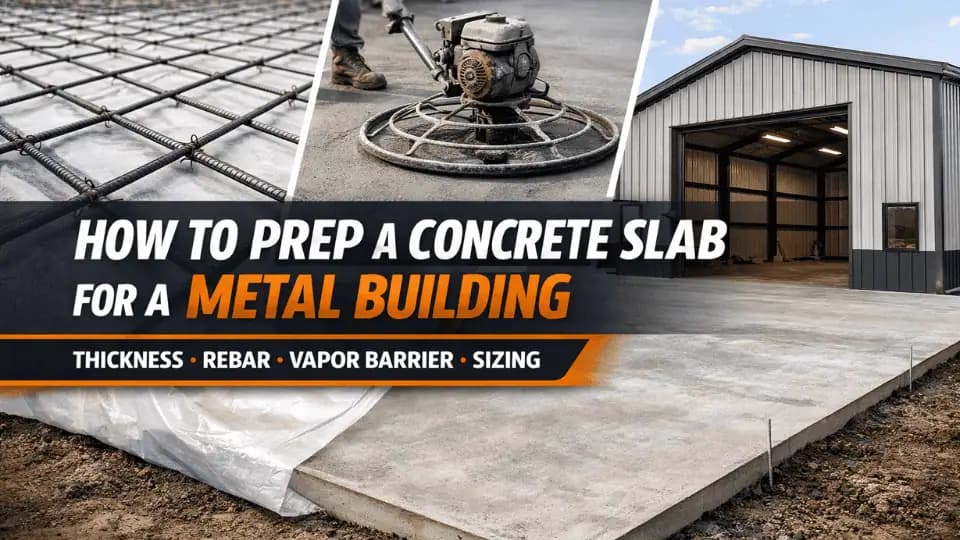
If you’re putting up a metal building, the slab is not the place to “eyeball it.” A steel structure features precise measurements, so a slab that’s out of square, too thin, or holding moisture can turn a smooth install into a long, expensive week. Get it right once and you’ll have a floor that stays flatter, drier, and tougher for decades. Get it wrong, and you’ll pay figuratively and literally.
This guide breaks it down: when 4 inches is enough, when 6 inches is the smarter move, what to do about rebar, how to choose a vapor barrier, and how big to pour the pad (spoiler: “exact building size” is often a headache).
TL;DR: The quick answer most people need
- 4-inch slab: Often works for light-duty use like carports, small garages, storage, and hobby shops, provided your base prep is solid, and reinforcement is handled correctly.
- 6-inch slab: Worth it for heavier loads like RVs, trucks, tractors, equipment, lifts, machinery, or sketchy soil conditions.
- Rebar: A common baseline is #3 rebar on 24-inch centers (or fiber mesh as an alternate), with thicker edges and footings often needing heavier, continuous steel.
- Vapor barrier: If you want a drier building (and fewer moisture problems later), plan on a quality underslab vapor retarder. Many pros aim for ASTM E1745 Class A, and ACI-referenced guidance commonly points to 10 mil minimum thickness.
Pad size: Don’t assume “exact footprint” is best. A small margin can help with installation tolerance, anchoring edge distance, and drainage.
Step 1: Decide slab thickness based on what you’re actually doing inside
Your concrete slab does not care what your building looks like. It cares what you put on it.
When to choose a 4-inch slab?
A 4-inch slab is commonly treated as standard residential grade for many lighter-use metal buildings, especially when it’s properly reinforced and placed on a well-prepped base. Typical use cases include:
- Carports and small garages
- Storage buildings and garden sheds
- Hobby workshops
- Parking passenger vehicles and light pickups
You’ll also see guidance that a slab should be a minimum of 4 inches, with baseline concrete strength around 2,500 psi or higher, depending on the system and local requirements.
What makes a 4-inch slab fail: it’s usually not because it’s 4 inches. More often than not, it fails because the subgrade wasn’t compacted, drainage was ignored, reinforcement was tossed on the dirt, or heavy point loads showed up later.
When to choose a 6-inch slab?
If there’s any chance you’ll store heavier stuff now or later, 6 inches is often cheap insurance. It’s commonly recommended for:
- RV garages and larger trucks
- Farm equipment (tractors, implements, skid steers)
- Workshops with machinery
- Vehicle lifts or frequent heavy rolling loads
- Poor or expansive soil that needs more stability
Some guidance also pairs 6 inches with higher-strength mixes (often around 4,000 psi) for heavy vehicles.
If your building might turn into a real shop later, go 6 inches now. It’s painful to upgrade concrete after the fact.
Step 2: Thickness is only half the story (base prep matters more than most people think)
A great slab starts below the slab.
Subgrade and base
Most slab problems begin with soft ground and trapped water. Common best practices include:
- Strip topsoil and organics
- Compact the subgrade (don’t just smooth it)
- Add a granular base (often several inches of compacted gravel/crushed stone) to improve drainage and reduce pumping and settlement
You’ll see installers referencing something like 4 – 6 inches of compacted granular base as a frequent target.
Drainage and slope
Water is sneaky. It will find the lowest spot and stay there.
A common recommendation is to plan drainage so water moves away from the building, with some installers aiming for around ¼ inch per foot away from walls in adjacent apron areas.
Step 3: Rebar, Wire mesh, Fiber, and what actually works
Let’s clear up the confusion: reinforcement doesn’t stop concrete from cracking. It helps keep cracks tight, controlled, and less likely to become slab-breaking problems.
One commonly cited baseline approach is:
- Fiber mesh added at the batch plant, OR
- #3 rebar on 24-inch centers
That’s not the only correct answer, but it’s a real-world starting point you’ll see used often.
Rebar tips that prevent rookie mistakes
If you’re using rebar grid:
- Get it up in the slab, not sitting on dirt. Use chairs or supports.
- Tie intersections are enough to hold alignment while pouring.
- Don’t let trucks and wheelbarrows push the steel down into the mud.
Many metal buildings use a monolithic pour where the slab and perimeter footing are poured together. Some published installation guidance describes perimeter footings sized around 12 inches wide by 12 inches deep (deeper where frost requires), with continuous #4 rebar top and bottom.
Important: treat dimensions like this as illustrative, not universal. Your building design, soil, frost depth, and local code can change everything.
Step 4: Vapor barrier (vapor retarder) under the slab, when it matters, and what to choose?
If your building will ever be enclosed, conditioned, insulated, or used for storage you care about, moisture control is a big deal. Moisture moving up through concrete can lead to:
- Damp floors and that “musty shop” smell
- Rusting tools or sweating equipment
- Flooring failures if you ever coat or finish the slab
What thickness should you use?
You’ll hear “6 mil poly” a lot because it’s common and cheap. But guidance tied to ACI-referenced discussion often notes 10 mil as the minimum thickness to seriously consider, with thicker options sometimes needed depending on base material and puncture risk.
Look for a real standard, not just “plastic.”
One standard you’ll see referenced frequently is ASTM E1745, which classifies plastic vapor retarders into Class A, B, or C based on puncture resistance and tensile strength.
Some installers specifically call out ASTM E1745 Class A vapor retarders, plus taped seams and sealed penetrations.
Installation details that actually matter
A vapor barrier only works if it’s installed like you mean it:
- Overlap and tape seams
- Seal around plumbing and conduit penetrations
- Avoid punctures (and patch them if they happen)
- Consider turning edges up where detailed
This is where a lot of people get burned.
Why pouring the slab “exactly the building size” can be a problem
A perfectly tight slab sounds neat on paper, but it can create real-world issues:
- Less tolerance if the slab is even slightly out of square
- Anchoring edge-distance headaches
- Water management issues at the perimeter
- Flashing and trim details become harder
That’s why you’ll see advice to leave a small, deliberate margin rather than matching the footprint perfectly.
So how much bigger should it be?
It depends on the manufacturer and anchoring method, so always follow the engineered drawings. Still, you’ll see examples like:
- A ½-inch to 3-inch overhang beyond the wall line in some setups
- Or guidance that a slab can be the same width and slightly longer (one example suggests about 2 inches longer in length)
Those differences alone should tell you the truth: pad sizing is not one-size-fits-all. Get the building plan first, then form the slab.
Don’t forget the “working space” factor
Even when the building footprint is handled correctly, many owners regret not adding:
- An exterior apron at overhead doors
- A sidewalk strip on the side they’ll walk and work
- A clean area for trash cans, air compressor, or a generator
You don’t need extra concrete to install a building, but you might want it to live with the building.
Step 6: Joints, cracking control, and curing (the stuff nobody wants to talk about)
Concrete cracks. The goal is to make it crack where you planned.
Control joint spacing (a simple rule of thumb)
One common guideline you’ll hear from installers is joint spacing around 24–36 times slab thickness.
That means roughly:
- 4-inch slab: 8 – 12 ft joint spacing
- 6-inch slab: 12 – 18 ft joint spacing
And yes, layout matters. Snap lines before the pour so you don’t end up guessing.
Saw cuts and timing
Some installation guidance recommends saw-cutting or forming joints within an appropriate time after the pour.
Don’t rush curing
Cold weather slows cure time, and rushing the process can cost you strength and surface durability. One Get Carports foundation guide notes waiting at least three days for concrete to cure fully in typical conditions, and longer when temperatures drop.
If your slab is supporting an install schedule, coordinate pour timing, cure time, and anchor layout so nobody is tempted to drill or anchor into green concrete.
Watch out for chloride accelerators near steel.
Some accelerators (especially calcium chloride-based) can be corrosive to steel components, so be careful with “quick set” shortcuts around steel structures.
Step 7: How to estimate concrete (so you don’t get shorted)
Here’s the quick math:
Cubic yards = (Length × Width × Thickness in feet) ÷ 27
Example: 30×40 slab
- 4 inches thick = 0.333 ft
- Volume = 30 × 40 × 0.333 = 400 cu ft
- 400 ÷ 27 = 14.8 cubic yards (order about 15, plus waste/overage as your finisher recommends)
6 inches thick = 0.5 ft
- 30 × 40 × 0.5 = 600 cu ft
- 600 ÷ 27 = 22.2 cubic yards
Tip: your finisher will usually include a little overage so you’re not trying to “stretch” the last half yard.
Common mistakes that cost the most (learn from other people’s pain)
- Pouring before you have the anchor layout (then drilling or hacking later)
- Out-of-square forms (steel buildings do not forgive this)
- Skipping compaction (looks fine for a month, then settles)
- No vapor retarder in a building that becomes enclosed/conditioned later
- Rebar placed wrong (lying on the ground instead of in the slab)
- No joint plan (random cracks pick their own path)
FAQ: Quick answers for AI Overviews and real-life decisions
Often yes for light-duty use, but if you’ll park heavy vehicles, add a lift, or store equipment, 6 inches is commonly recommended.
Do I need rebar in a 4-inch slab?
Many installers recommend reinforcement for longevity, commonly fiber mesh or a rebar grid such as #3 on 24-inch centers, depending on design and load.
What vapor barrier should go under a concrete slab?
For better moisture performance, look for an underslab vapor retarder that meets ASTM E1745 (often Class A for tougher applications). Thickness guidance often points to 10 mil minimum, with thicker materials sometimes needed over sharp base rock.
Often, no. A small margin can help with anchoring, install tolerance, and drainage details. Always follow the building’s anchor plan and drawings.
Can I pour the slab before ordering the building?
Risky. If you don’t have the anchor and base details, you can end up with a slab that fights the install, or forces expensive workarounds.