- 1. Ignoring roof slope rules
- 2. Treating wind uplift as marketing fluff
- 3. Choosing the wrong gauge to “save a little”
- 4. Overlooking paint chemistry and warranties
- 5. Using the wrong metal in coastal zones
- 6. Forgetting galvanic and chemical corrosion
- 7. Skimping on underlayment and ice protection
- 8. Ignoring condensation control
- 9. Misunderstanding energy claims
- 10. Overdriving screws and skipping closures
- 11. Ignoring thermal movement
- 12. Panicking about oil canning
- 13. Forgetting regional add-ons like snow retention
- 14. Mixing up hail ratings
- 15. Hiring on price without vetting the crew
- A simple, 10-minute checklist before you sign
- Our Final Word
If you ask ten people why they picked metal, you’ll hear the same hits: long service life, high wind resistance, fewer leaks, and clean looks. All true. Yet I’ve also spent years fixing metal building roofs that never should have failed. The problem isn’t the material. It’s avoidable choices made on day one.
Below is a practical, simple guide for farmers putting up a new hay barn, contractors bidding on a shop, and homeowners replacing a roof. Keep it handy while you compare bids.
1. Ignoring roof slope rules
Most thorough-fastened panels need steeper slopes. Standing seam can go lower, but only when the profile and details are rated for it. Industry guidance and codes commonly cite a 1/4:12 minimum for many standing-seams, while exposed-fastener panels typically call for 3:12, unless special sealants and details are used. Choosing a profile outside its tested slope range means- leaks.
Quick check: Match the panel to the actual pitch on your plans. If the bid doesn’t mention a number, ask your manufacturer for the installation manual page.
2. Treating wind uplift as marketing fluff
Coastal counties, plains states, and open farm sites see serious suction on roof edges & corners. Don’t accept a generic ‘high-wind’ claim. Ask for the test standard and the design pressures the system passed. For metal buildings, the benchmark for metal roofs is ASTM E1592 for the structural performance of sheet-metal roof systems. UL 580 and UL 1897 are also widely used. Pick assemblies with test reports that cover your purlin spacing or deck type.
Florida or HVHZ buyers: Look for a Miami-Dade Notice of Acceptance (NOA) for your exact panel and substrate. No substitutions.
3. Choosing the wrong gauge to “save a little”
Steel thickness matters. Thinner panels oil-can faster, dent sooner, and struggle in hail & high winds. Many homes and shops are made of 26 or 24 gauge [heavy-duty]; 29 gauge is cheaper but lighter duty. If you’re in snow, hail, or high-wind country, taking a chance isnt an option.
4. Overlooking paint chemistry and warranties
Paint is more than just how it looks, it handles chalk & fade. PVDF (Kynar 500/ Hylar 5000) coatings retain color and gloss better than standard SMP on most buildings, and PVDF typically comes with stronger chalk & fade coverage. If you’re near salt air, read the fine print: many standard paint and substrate warranties exclude projects within about 1,500 ft. of breaking surf unless you use specific coastal systems.
5. Using the wrong metal in coastal zones
Salt is relentless. Galvalume performs very well inland, but most Galvalume warranties exclude structures close to saltwater. Aluminum or stainless and coastal-rated finishes are common choices at the shore. Verify your installer’s plan against both the paint warranty and the substrate warranty before you sign.
6. Forgetting galvanic and chemical corrosion
Dissimilar metals can eat each other when they come in contact. Copper runoff will attack steel, aluminum, and zinc. ACQ and other copper-bearing treated lumbers can also corrode certain steel panels and fasteners. Use separation membranes, compatible fasteners, and manufacturer-approved details anywhere metals or treated wood meet.
7. Skimping on underlayment and ice protection
Underlayment is not ‘just paper’. Codes reference ASTM standards for felts and self-adhered membranes, and high-wind regions require heavier grades and specific fastening. In cold regions that see ice dams, the IRC calls for an ice barrier at eaves that extends a set distance up the roof plane to protect against backup. Make sure your bid names the product and shows where it goes.
8. Ignoring condensation control
Metal sheds water, but warm interior air still finds cold surfaces. Barns, shops, and conditioned homes all need a plan: ventilation, insulation, and if required, a vapor retarder. Don’t rely on – “the metal will handle it”. Ask for a simple dew-point and ventilation strategy for your assembly.
9. Misunderstanding energy claims
Cool metal roofing can reduce peak cooling loads and surface temperatures, especially in hot climates, but performance depends on color, coating, insulation, and climate. Also note that the ENERGY STAR roofing label was a thing of the past, not a seal of approval anymore. Instead, compare SRI values and reputable test data.
Also Read: Metal Buildings vs. Pole Barns
10. Overdriving screws and skipping closures
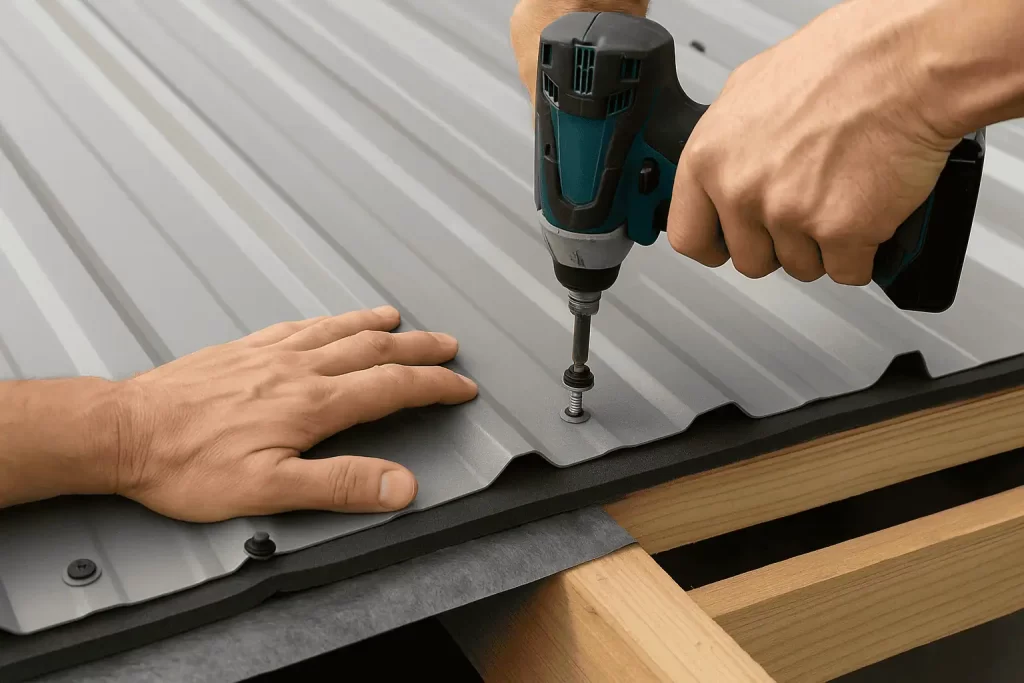
Most leaks I diagnose trace back to hands and habits, not panels. Common offenders: over-driven screws, missing butyl tape at sidelaps, and no foam closures at eaves and ridges. Your drawings should show butyl tape at panel laps and shaped closure strips where profiles meet trim. Make this visible in the submittals, not an afterthought.
11. Ignoring thermal movement
Long panels move with temperature swings. Standing seam uses clips and slotted holes to let panels expand and contract. Edge trims and gutters need room to move too. Locking everything down tight creates noise, oil canning, or fastener fatigue. Ask how the clip system, trim, and penetrations accommodate calculated movement.
12. Panicking about oil canning
Those soft waves you sometimes see in flat metal aren’t necessarily a defect. Oil canning is an inherent cosmetic phenomenon in flat areas of light-gauge panels and doesn’t affect performance. You can reduce its appearance with thicker metal, narrower panel widths, striations, and good installation practice, but no one can promise ‘zero’.
13. Forgetting regional add-ons like snow retention
If you live where roofs hold snow, plan a snow retention layout that matches your panel type and spans. The goal is to manage release, not trap every flake. Put this in the design, not as a winter emergency.
14. Mixing up hail ratings
If hail is part of your weather story, look for UL 2218 Class 4 assemblies. That rating speaks to impact resistance of the covering; it doesn’t make a roof “hail proof,” and it doesn’t replace good gauge and profile choices.
15. Hiring on price without vetting the crew
Prequalify your roofer: business location, licensing where required, insurance, references with addresses you can see, and written scope with the exact panel, substrate, coating, underlayment, and details. NRCA and MRA offer solid checklists.
A simple, 10-minute checklist before you sign
- Panel and pitch match the manufacturer’s minimum slope for your roof.
- Wind uplift testing identified by standard and design pressure for your exposure and substrate.
- Gauge and metal type fit your climate and use.
- Coating chemistry and warranties spelled out, including any coastal exclusions.
- Underlayment type and fastening listed, plus ice-barrier where required.
- Condensation plan: ventilation, insulation, and any vapor retarder noted.
- Laps, butyl tape, and foam closures are shown on details.
- Thermal-movement strategy described for panels and trims.
- Hail or snow accessories included where relevant.
- Contractor credentials verified per NRCA and MRA guidance.
Our Final Word
Metal is a fantastic choice for barns, shops, and homes, but it requires good decisions. Match the panel to the pitch. Respect wind, water, and movement. Specify the little parts no one sees. And pick a crew that can prove they’ve done it right before. Do that, and you’ll enjoy the reasons people pick metal in the first place: clean lines, quiet service, and a roof you don’t have to think about for a very long time.
More more info, Call Us Today at (866) 681-7846 for a Free Consultation!