- Key Highlights
- Why Steel Origin Actually Matters for a Metal Building
- What "American Steel" Actually Means
- Domestic Mills and Consistent Coating Standards
- Why Get Carports Builds With 100% American Steel
- What Changes When a Building Uses Imported Steel
- Coating Weight and Corrosion Resistance Can Vary
- Certification and Code Compliance Gets Harder to Verify
- American Steel vs. Imported Steel: Side-by-Side Comparison
- What This Means for Your Warranty, Certification, and Long-Term Cost
- Warranty
- Code Certification
- Long-Term Cost
- Which Buyers Should Care Most About Steel Origin
- How to Verify Steel Origin Before You Buy
- Why Choose Get Carports
- Frequently Asked Questions
- Does Get Carports use American steel or imported steel?
- Why does it matter if steel is American-made or imported?
- Does imported steel rust faster than American steel?
- Does steel origin affect my metal building's wind and snow certification?
- Is American steel more expensive than imported steel?
- What gauge and coating does Get Carports use?
- How do I know if a metal building company uses American steel?
- Conclusion
Two metal carports can look identical on paper. Same size, same roof style, same 14-gauge frame listed on the spec sheet. Ten years later, only one still looks the way it did on install day.
More often than people expect, the difference between these two structures traces back to where the steel came from and how consistently it was coated, long before either building ever reached a job site.
Get Carports builds every structure with 100% American steel. Below, we’ll explore what that actually buys you, and what changes when a metal building is framed with imported steel instead.
Key Highlights
Get Carports builds every carport, garage, and barn with 100% American-made, galvanized steel.
Domestic steel mills produce to consistent ASTM specifications, which keeps coating thickness and corrosion resistance predictable from one building to the next.
Imported steel coil can vary in coating weight and gauge tolerance from shipment to shipment, even when the spec sheet lists the same numbers.
Coating consistency is what a rust-through warranty is actually backed by. A thinner or uneven zinc coating shortens the lifespan before rust starts.
Code certification depends on verified material specs. Domestic steel gives engineers a shorter, more traceable supply chain to certify against.
Building with American steel also means less exposure to overseas shipping delays and import tariffs that can shift pricing with little notice.
Design Your Building at GetCarports.com or call (888) 904-9796 to build with 100% American steel, backed by our 20-year rust-through warranty.
Why Steel Origin Actually Matters for a Metal Building
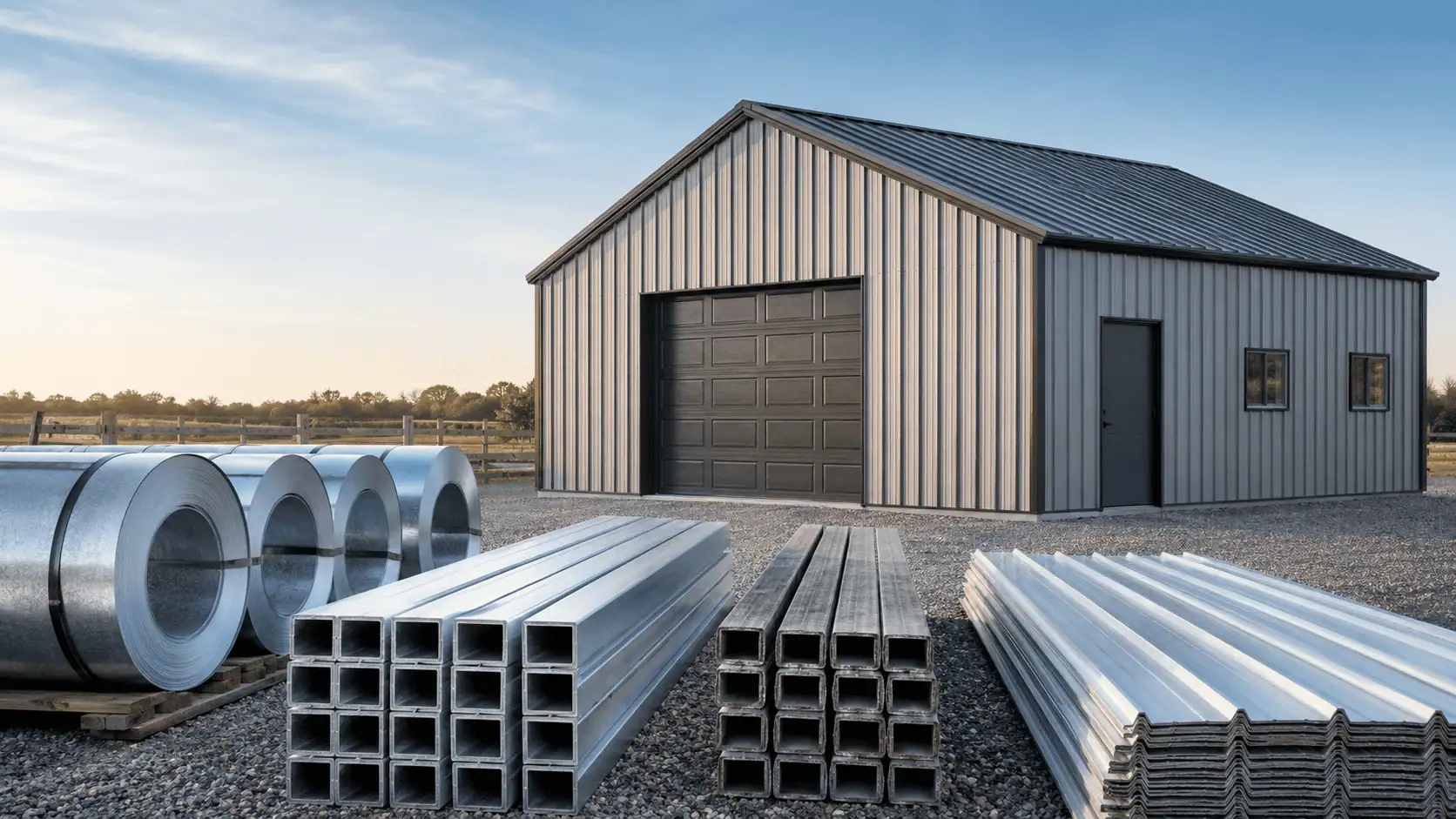
Every metal building starts as a steel coil before it's rolled into tubing and panels. Where that coil comes from decides more than a line on a spec sheet. It decides how tightly the coating thickness is controlled, how consistent the gauge stays from one batch to the next, and how easily an engineer can certify the finished structure to your local wind and snow code.
None of that shows up on a price tag right away. It shows up ten or fifteen years in, when one building is still holding paint and another is streaked with rust.
What "American Steel" Actually Means
Domestic Mills and Consistent Coating Standards
Steel made in the United States is produced under ASTM specifications that set tight tolerances for thickness, strength, and zinc coating weight, often referred to in the industry as G-90 galvanizing. That coating is what actually stops your frame from rusting.
Domestic mills are held to that standard on every coil, batch after batch. That consistency is what lets a manufacturer certify a building to a specific wind or snow rating. Every coil behaves the way the engineering plans assume it will.
Why Get Carports Builds With 100% American Steel
Every carport, garage, and barn we sell is built with 100% American-made, galvanized steel, backed by a 20-year rust-through warranty. That warranty only means something if the steel behind it holds up the way it's engineered to. That's exactly why we don't source frame or panel steel from overseas mills.
What Changes When a Building Uses Imported Steel
Coating Weight and Corrosion Resistance Can Vary
Imported steel coil isn't held to the same enforcement standards as domestic steel, even when a spec sheet lists a matching gauge and coating designation. Coating weight can run thinner on one shipment than the last, and that difference stays invisible until the building has been outside for a few years.
Thinner coating means less zinc standing between bare steel and moisture. Once that layer wears through, rust moves fast, especially at seams, cut edges, and fastener holes.
Certification and Code Compliance Gets Harder to Verify
Wind and snow certification depends on knowing exactly what the steel in front of an engineer can handle. A shorter, domestic supply chain makes that easy to verify. An imported supply chain that changes suppliers between shipments makes it harder to guarantee the same performance on every unit.
That gap matters most in high wind and heavy snow regions, where a building's rated performance is the entire reason you paid for a certified structure instead of a cheaper uncertified one.
American Steel vs. Imported Steel: Side-by-Side Comparison
Factor | American Steel (Get Carports) | Imported Steel |
|---|---|---|
Coating consistency | Controlled to ASTM specs, batch after batch | Can vary by shipment, even at matching spec |
Corrosion resistance | Predictable, backed by a 20-year rust-through warranty | Depends on the coating weight of that specific coil |
Code certification | Traceable domestic supply chain | Harder to verify consistently across shipments |
Supply stability | Fewer shipping delays, less tariff exposure | Subject to overseas shipping delays and import tariffs |
Gauge tolerance | Tight, consistent tolerances | Can vary from the labeled spec |
Warranty backing | Backed by the manufacturer that sourced the steel | Depends on knowing the steel's actual origin |
See these materials in a real build: Compare the 20'x20'x7' Closed Carport, 24x30x9 Two Car Garage, and 36'x40'x12 Raised Center Barn.
What This Means for Your Warranty, Certification, and Long-Term Cost
Warranty
A 20-year rust-through warranty is only as strong as the steel behind it. Get Carports backs every structure with that warranty because we know exactly what coating and gauge went into your building, coil by coil.
Code Certification
Every Get Carports structure is engineered and IBC certified to your local wind and snow load requirements. That certification depends on knowing precisely what the steel can handle, which gets a lot harder to guarantee when a supply chain runs through multiple overseas suppliers.
Long-Term Cost
Imported steel carries more exposure to tariffs and overseas shipping costs, both of which can shift a quote with little warning. For the deeper breakdown on how tariffs move metal building prices, our guide on how steel tariffs impact metal carport prices covers that in more detail.
Which Buyers Should Care Most About Steel Origin
Farmers building a barn or equipment shed live with that structure through every humid summer and freeze-thaw winter for decades, not years. Coating consistency is what decides whether that barn is still solid at year 20 or needs panel replacement at year 8.
Contractors managing a client's build carry the liability if a structure doesn't perform the way it's certified to. A traceable, domestic steel supply chain gives you a certification you can actually stand behind.
Homeowners ordering their first carport or garage often notice last, usually around year 5 or 6, when rust starts showing up on a cheaper import-framed structure faster than the spec sheet ever suggested it would.
How to Verify Steel Origin Before You Buy
Most metal building companies won't volunteer where their steel comes from unless you ask directly. A few specific questions get you a real answer instead of a marketing line.
Ask where the steel is milled, not just where the building is assembled.
A structure can be "built in the USA" while the raw steel coil itself was imported and only cut and formed domestically.Ask what coating weight the panels carry.
G-90 is the industry benchmark for galvanized coating on metal buildings. A company that can't answer this quickly usually hasn't asked their own supplier either.Ask if the warranty is tied to the steel's origin.
A rust-through warranty backed by a company that knows exactly what coil went into your building carries more weight than one backed by a company several steps removed from its own supply chain.Ask how gauge tolerance is checked.
Domestic mills hold tighter tolerances, batch after batch. A vague answer here is worth following up on before you order.
If a building specialist can answer all four without hesitation, you're likely looking at a traceable, domestic supply chain. If the answers get vague, that's worth factoring into your decision as much as price or size.
Why Choose Get Carports
Every carport, garage, and barn we build starts with 100% American-made, galvanized steel, typically 14-gauge framing and 29-gauge panels. Every structure is engineered and IBC certified to your local wind and snow load, and backed by a 20-year rust-through warranty because we know exactly what steel went into it.
Free delivery and professional installation are included on every order, with $0-down rent-to-own and traditional financing available if you'd rather not pay all at once.
Design Your Building at GetCarports.com or call (888) 904-9796 to build with American steel you can actually count on.
Want to price a building with these specs? Design your building in the 3D Estimator, request a free quote, or call (888) 904-9796.
Frequently Asked Questions
Does Get Carports use American steel or imported steel?
Every carport, garage, and barn we build uses 100% American-made, galvanized steel. We don't source frame or panel steel from overseas mills.
Why does it matter if steel is American-made or imported?
American steel is produced to consistent ASTM specifications for thickness and zinc coating, which keeps corrosion resistance predictable from one building to the next. Imported steel can vary in coating weight between shipments, even when the spec sheet lists the same numbers.
Does imported steel rust faster than American steel?
It can, if the zinc coating on that particular shipment runs thinner than what's labeled. Once the coating wears through, bare steel is exposed to moisture and rust moves quickly, especially at seams and fastener holes.
Does steel origin affect my metal building's wind and snow certification?
Yes. Certification depends on knowing exactly what the steel in front of the engineer can handle.
Is American steel more expensive than imported steel?
Not necessarily, and it tends to hold steadier over time. Imported steel carries exposure to overseas shipping costs and import tariffs, both of which can shift pricing with little notice.
What gauge and coating does Get Carports use?
Most Get Carports structures use 14-gauge steel framing and 29-gauge panels, galvanized for corrosion resistance and backed by a 20-year rust-through warranty.
How do I know if a metal building company uses American steel?
Ask directly where the steel is sourced and whether the rust-through warranty is tied to that sourcing. A company that can answer both questions clearly is usually working with a domestic, traceable supply chain.
Conclusion
A spec sheet can list the same gauge and the same coating on two different buildings and still hide two very different outcomes ten years down the road.
Get Carports builds every structure with 100% American steel because that's the only way we can back a 20-year rust-through warranty with confidence, batch after batch.
Ready to get started? Design Your Building at GetCarports.com or call (888) 904-9796, and build with steel you already know the story of.